Just Us Bridge / proposed initiatives / Chicago + Cook County
Use AI.Check every cite.Build your case.
A confident AI answer can cite a case that never existed. Teach people facing court to govern the machine, check the law, and build a research system they control.
Proposed for Chicago and Cook County: a legal-AI course for every learner, a hands-on research-harness lab for interested participants, a source-linked JUB tool, and new episodes that show the method in action. The foundation is Jim Winner's litigation-literacy framework and JUB's existing scripts, cited treatises, scenes, and assessments.
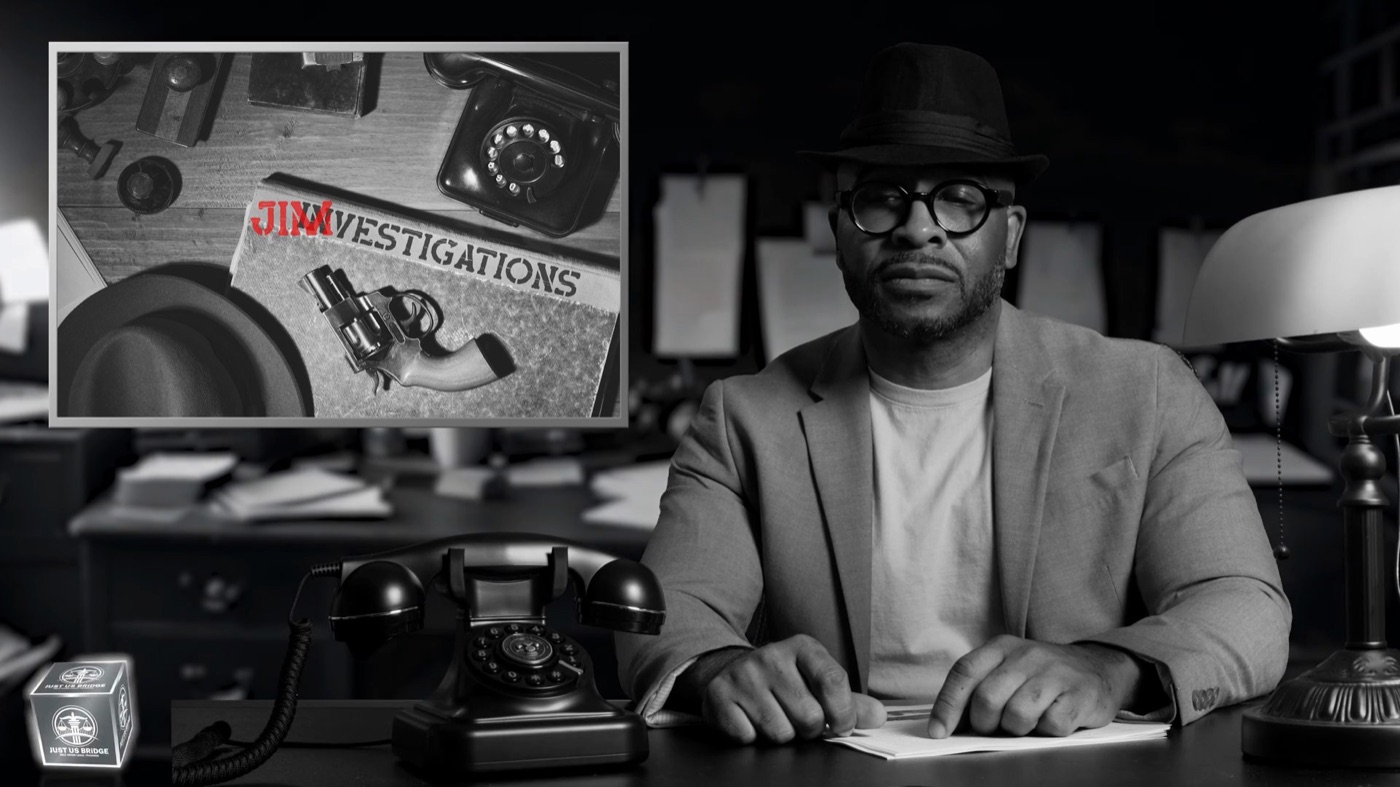
The show already turns legal research into a scene people remember. The next program teaches them how to check a machine's answer against the source.
Make the machine show its work.Residents should be able to open the cited opinion, test the rule against their facts, find contrary authority, and reject an answer that fails any check.
The need is measurable
People will use AI in court. Many will have no lawyer to check it.
Access to a chatbot does not tell a tenant which deadline matters, whether a citation exists, or what to say when a hearing takes a turn.
51 / 18percent of adults with a bachelor's degree versus a high-school education or less who had used ChatGPT in Pew's 2025 survey.
Pew Research Center, 2025
The disparity is local, too. Black residents were less than 23% of Cook County's population but almost 51% of tenants observed in its eviction courts. Those are court-watching observations, not a countywide census. The AI-use figures are national and describe ChatGPT use, not legal competence. Together they show why a local program should teach both litigation and verification skills. Source
350+In February 2026, the National Center for State Courts reported more than 350 documented U.S. cases in which self-represented litigants cited nonexistent cases, statutes, or quotations generated by AI. Illinois courts have separately warned that fabricated authority in a filing can lead to sanctions. Teach citation checking before the first AI-assisted document reaches a clerk. NCSC · Illinois Courts
JUB has already taught the underlying skill. In the eviction course, all 36 learners with paired intake and final exams improved, and the average score rose from 66 to 83. Program viewing records show that approximately 47% of signups watched at least one instructional video. Jim Winner's litigation-literacy preprint
Proposed 12-episode production slate
The series keeps going where the case goes.
Viewers should not have to stop learning after the introduction. The proposal maps the next decisions, the hard turns, and the subjects they are already asking about.
04AI on trial
Catch a fake case; check a real holding; build a source-linked research harness; govern the final AI-assisted work before a filing.
04Civil case moves
Discovery demands, hearing preparation, making a record, and the first appeal decision. Each episode branches when the opponent refuses, the judge rules, or a deadline changes.
02Know your rights
Police-stop and school-encounter rehearsals that teach clear words, calm conduct, when to stay silent, and how to preserve the account for later review.
02Money and housing
Debt collection and updated eviction problems chosen from resident questions and current local practice, with linked forms, sources, and what-if exercises.
This is an editorial proposal, not a claim that twelve episodes are already written, filmed, or approved. The existing library contains 26 finished episodes, with 19 on the public site across three series. The proposed season would use the established JUB sequence: cited treatise, writers' room, legal review, filming, edited episode, and learning check. Local rules and examples would be reviewed again before recording or release. See the existing-library scopes.
Illustrative project budgets
Plan the learning, the tool, and the next season.
Equipment helps. The costly work would be teaching, producing, reviewing the law, testing safety, and getting the material to people before a deadline.
These are planning figures, not a Society offer or solicitation. The partnership brief lists separate archive and production examples, including a $1M concept with 20 original episodes and 60 short videos. The $1M AI concept below combines 12 episodes with teaching, a participant tool, and evaluation. A Society role would require a written license and separate approvals.
$150KTeach and test AI governance.
Build the six-session course and a small Builder Lab. Run Chicago and suburban Cook County pilots. Measure whether learners catch invented citations, identify the governing source, and keep private facts out of unsafe tools.
$500KPublish the first harness and episodes.
Release reviewed research-workspace templates and a limited source-linked JUB prototype. Train facilitators, produce the first AI-on-trial episodes, and test the tools against planted legal errors with residents.
$1MServe the county for a year.
Fund the twelve-episode season, a maintained participant tool, coached core and Builder Lab cohorts at multiple sites, language access, independent evaluation, and a year of source updates.
What a $1M year could buy
- $300K: twelve episodes, shorts, editing, captions, and production crew
- $260K: core course, Builder Lab, source-linked tool, engineering, and security
- $180K: facilitators, community delivery, participant access and support
- $120K: legal review, privacy, language access, and accessibility
- $90K: independent evaluation, red-team exercises, and reporting
- $50K: infrastructure, insurance, and administration
How we would report it
Report signups, unique viewers, one-lesson reach, cohort attendance, pretest and post-test scores, citation-check performance, and use of the issue index separately. Test whether participants can spot a fabricated authority, find adverse law, identify a deadline, and explain why a source does or does not govern. Count completed research harnesses only after a participant runs the error tests and documents a human review. Any later case-outcome study would require consent and a separate research design.
All scopes and allocations are planning figures, not vendor quotes or commitments. A final grant budget must match the selected entity, personnel plan, venue, and partner agreements.